Have you ever wished easily finding India's beautiful local pottery?

My Role
User Research
Contextual Inquiry
System Thinking
UX Strategy & Framework
Ideation
User Interface
Design Criteria
Tools
Figma
Google Suit
Miro
FigJam
Google Forms
Duration
10 Weeks
Overview
India’s extensive cultural legacy dates back over 4,000 years, is strongly intertwined to the handicraft sector in India. I was constantly in awe of the craftsmen who created the artifacts because of the wonderful craftsmanship I was surrounded with, from textiles to pottery to jewelry.
The skills of these craftsmen were quickly replaced by machines with the industrialization, modernization, and production of mass-produced goods.
However after Covid attacked in 2020 and imports from other nations were stopped or restricted in India, our nation came to understand the ability we had to meet our own requirements and replace things that were often imported from other nations with our own domestic goods. I chose to focus my research on the immense talent and manpower in the handicraft industry, which has such massive potentials on a national and international level. I chose to focus on the pottery industry because it is very old, is known for its intricate designs, and is valuable in most Indian households.

The subject of study is to recognize and revive the rich cultural
heritage of the artisans in India who have lost their value due to modern machinery practices.
Research Model

DATA COLLECTION:
• Quantitative Data: Surveys and secondary research materials are used to gather statistics.
• Qualitative Data: Interviews with the target audience, as well as already published research papers and studies, might help to expand on the insights.
DATA PROCESSING:
• Mind maps
• PESTEL analysis
• ERAF maps
• Stakeholder map
DATA ANALYSIS
• SWOT analysis
• 2 x 2 map
• Affinity diagram
DATA SYNTHESIS
• Value proposition canvas
• Insights
• Value pillars
Potters strive for the need for recognition and support for their craft. Many potters struggle to earn a decent livelihood from their work, and they often lack access to resources and support to improve their skills and market their products
Target Audience

Online Survey and Interviews
In an effort to gather information about people's perspectives and knowledge of the Vocal for Local model a questionnaire was created. The questionnaire comprised a series of questions that were intended to capture a wide range of information about the handicraft industry, the access that people have to pottery items and its significance.
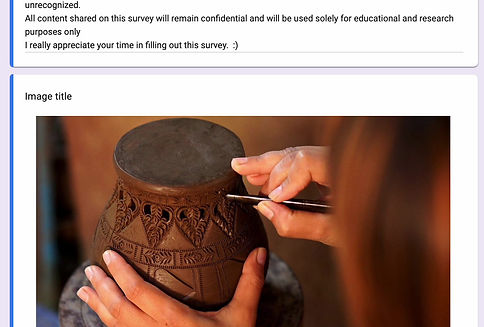
The survey and interviews validated some insights from secondary research. Here are some of the major insights that were captured from both surveys and interviews


Opportunity Statement
Based on my research and findings, I found an opportunity space that may offer a solution that can restore the rich heritage and value of the artisan community in India.
How might the use of design management techniques facilitate the creation of employment opportunities for India’s undervalued skilled artisans?

Final Insights
01
The labor- and detail-intensive nature of the handicraft business makes it pricey while also being rich in cultural history.
04
To promote handicrafts, increase demand for them, and highlight their cultural significance even in global marketplaces, it is important to educate and raise awareness.
02
The generations of craftspeople are desperate for praise and money to preserve their tradition.
05
Aid from government agencies, NGOs that can enhance and market locally made crafts, and individuals showcasing their skills
03
To market handicrafts and create brand partnerships, use social media, internet, retail channels, and communities
06
The dedication of craftspeople is not sufficiently recognized and compensated.
The Solution
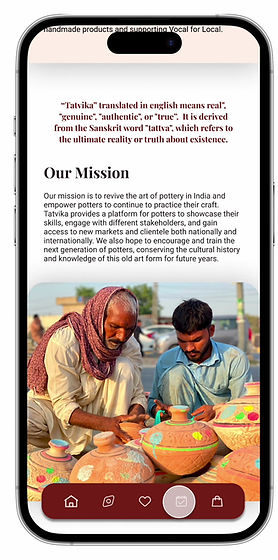
“Tatvika” translated in english means real", "genuine", "authentic", or "true”. It is derived from the Sanskrit word "tattva", which refers to the ultimate reality or truth about existence.
Vision: Our objective is to build a thriving platform that honors and empowers India's potter community. We foresee a future in which craftsmen have the resources, networks, and recognition they require to demonstrate their talent, maintain their tradition, and establish sustainable livelihoods. We envision a future in which Indian craftsmen are widely acknowledged and respected for their unique talents, creativity, and contribution to humanity's cultural heritage.
Mission: Our mission is to revive the art of pottery in India and empower potters to continue to practice their craft. Tatvika provides a platform for potters to showcase their skills, engage with different stakeholders, and gain access to new markets and clientele both nationally and internationally. We also hope to encourage and train the next generation of potters, conserving the cultural history and knowledge of this old art form for future years.
Core Values:


Advancement
Encouragement
Awareness

Brand Identity

Value Proposition

Value Pillars

Empathy Map

User Flow
Jaya wanted to buy pretty blue pottery, especially plates and cups, after her friend told her about the cool stuff in Delhi. So, she searched on Google and found a shop called Tatvika that sells these beautiful things. When she went to their website, she saw lots of colorful blue pottery on the main page. Jaya clicked on "Plates and Cups" to see more. She liked a plate and added it to her cart. Then, she looked at the cups and picked one she liked, adding it to her cart too. After that, she paid for them securely and got a message saying her order was confirmed. Now, she's excitedly waiting for her new blue pottery from Tatvika to arrive and make her home look awesome!

Information Architecture
After deciding the product goals, I mapped down the IA to be directed towards labeling, structuring and organizing the application process.

Design Criteria

Next Steps

Phase 1:
-
Investigating the methods and abilities of the craftspeople to produce content for the website and exhibitions.
-
Establishing partnerships with companies and design firms to increase market presence.
Phase 2:
-
Breaking down geographical barriers and promoting the website with the help of state government.
Phase 3:
-
Organizing artisan workshops and community activities that will help boost pottery market.
Pottery as a craft has been practiced for thousands of years, and it is known for its ability to create beautiful and functional objects out of clay or mud. When a potter sits down at the wheel or with a lump of clay in their hands, they are engaging in a process that connects them to the earth and to the history of their craft. Each piece that potter creates is unique, with its own shape, size, and character. Because pottery is made by hand, there are often slight variations and imperfections that give each piece its own personality